
Cookie Girl
Some thoughts on loving baking and growing up with undiagnosed autism.

I’m not one for television. I have the shows I like, but I’m not very likely to just turn on the TV and scroll for something to watch. There is one major exception to this: cooking shows. I’ve watched Food Network for as long as I can remember. Growing up, I watched all their shows, but the instructional ones were always my favorite: Giada at Home, 30 Minute Meals with Rachel Ray, and Trisha’s Southern Kitchen with Trisha Yearwood.
These hosts always stood in what I assumed were their home kitchens, even though they all looked suspiciously similar. The shows were formulaic, beginning with the host explaining what she was cooking for—a picnic, a cocktail party, a friend’s baby shower—while standing behind her kitchen island. She was always surrounded by beautiful things: color coordinated utensils on a shelf behind her, a big window providing a peek into her garden, and of course her KitchenAid stand mixer. Even if it was never used during the show, the mixer was always on some counter, out of direct view but somehow impossible to miss.
In middle school, when I started to cook on my own for the first time, I was not working with such luxury. My family had a tiny old kitchen. The cabinets were painted green and sometimes closed at an angle. We had a vintage yellow oven, with no built in timer or light. When I wanted to check on the food I was cooking, I looked through a circular glass panel into the oven and squinted.
Once, my brother Micah and I attempted to film our own episode of Chopped. He hid four ingredients under the woven basket we kept our napkins in. He filmed the dramatic intro and then followed me around the kitchen as I struggled to finish cooking within the time limit. I did manage to make Trisha Yearwood’s snickerdoodle recipe quite frequently. I would plug in my mom’s old stand mixer on the kitchen table, put my headphones in, and dance around the kitchen, while rolling the dough in cinnamon sugar.
After giving cookies out to my friends several times at school and watching the way people crowded around us with the anticipation of getting one, I decided to start selling them. I made about twenty bucks before my parents told me that it was fine if I wanted to keep selling the cookies, as long as I started paying for the ingredients myself. I guess you could say I was popular in middle school. I had a fairly large group of friends, and even people I wasn’t particularly friends with knew who I was: the cookie girl.
It was almost inevitable then, that I thought my life would be complete if I had a KitchenAid stand mixer. Specifically, I wanted the KitchenAid Artisan Series, 5-Quart, Tilt Head Stand Mixer with its ten-speed switch, metal bowl, and all the possibilities promised by at least twenty attachments. I made my mom watch an infomercial about the mixer and all its capabilities. It included some cooking demonstrations, interviews with families who had bought the mixer, and frequent still images telling you the mixer only cost $499.
I was in love! I found the entire 45-minute presentation thrilling. I did get the KitchenAid Artisan Series, 5-Quart, Tilt Head Stand Mixer for Christmas, my one present that year from the entire family. I was ecstatic, but when I tried to use it for the first time, I encountered a problem. The cord was three pronged and our kitchen outlets only had two prongs. So a few days after Christmas, Micah and I carried my mixer and all the ingredients for dinner rolls to our remodeled garage where we set up a folding table next to one of the outlets. Thankfully, we had an electrician friend switch the kitchen outlets a few weeks later.
My intense desire to own a KitchenAid Artisan Series, 5-Quart, Tilt Head Stand Mixer was one of the first things I thought about when I was fourteen and beginning to wonder if I was autistic. It was part of a long list of things that I was starting to rethink after discovering the autistic community online.
I knew how dangerous it was to diagnose yourself with something without talking to a doctor, so I told my parents, then my therapist, and eventually got an appointment with my pediatrician. I felt like I had read every article and watched every video about late diagnosed autism on the internet. They all told me it was important to make a list of reasons I was pursuing a diagnosis, so the doctor wouldn’t dismiss me. I did just that, making a list on a Google Keep note I titled “signs.”
When I met with the doctor, I read the list which included my intense interest in Helen Keller, and the fact that I hate change to the point where starting high school made me actively suicidal. As I read the list, she kept shaking her head. I started to cry and lose my ability to speak. She didn’t address this directly, instead telling me: “Everyone struggles with change, you're gonna be okay.” When I mentioned Helen Keller she said: “Liking Helen Keller doesn’t have anything to do with autism, autism is boys who like trains and can’t have tags in their shirts.” She then looked to my mom: “Does she have any issues with tags?”
I tried to express, through my closed red throat and tears, that I did hate change more than everyone else. She responded: “You’re a teenager, it’s hard for everyone. You’re gonna be okay. Would you like to see a therapist here?” I said no, that I liked the therapist I had—even though I didn’t—and we left.
I wish I could tell you that I’m exaggerating for dramatic effect. I wish I could tell you that the dismissal and condescension the internet warned me about never happened, but it did and I was devastated. I deleted the list soon after, too embarrassed that I ever had an excuse for being so weird. I was just like everyone else, except everyone else was able to deal with it better.
According to the Diagnostic and Statistical Manual of Mental Disorders (the DSM), one of the key criteria for diagnosing autism is: “Restricted, repetitive patterns of behavior, interests, or activities.”1 Although my love for Helen Keller was certainly repetitive: I checked out every book on her from the library and wrote about her in every school report I could, I didn’t experience it as restrictive. When I was in fourth grade and my oldest brother had his high school graduation party at the house, I was in my room trying to finish Helen Keller’s autobiography before it was due back to the library. My mom eventually made me go outside to socialize, but was I really doing anything wrong? That surely couldn’t qualify as restrictive behavior, could it? I was just a kid wanting to read a book, wasn’t I?
The DSM also highlights: “Insistence on sameness, inflexible adherence to routines, or ritualized patterns of verbal or nonverbal behavior.”2 When I told my doctor about my struggle with change, I only mentioned big changes that would have anyone shaken up. I didn’t mention how I couldn’t function whenever there was a random day off of school, a substitute teacher, or a change in dinner plans. I thought everyone struggled with those things as much as I did.
So, while I still felt like there was something wrong with me, I went back to baking. We remodeled our kitchen: the sink wasn’t so close to the oven, the new cabinets closed properly, and we had usable counter space. My KitchenAid Artisan Series, 5-Quart, Tilt Head Stand Mixer took its rightful place sitting at the corner of the countertop.
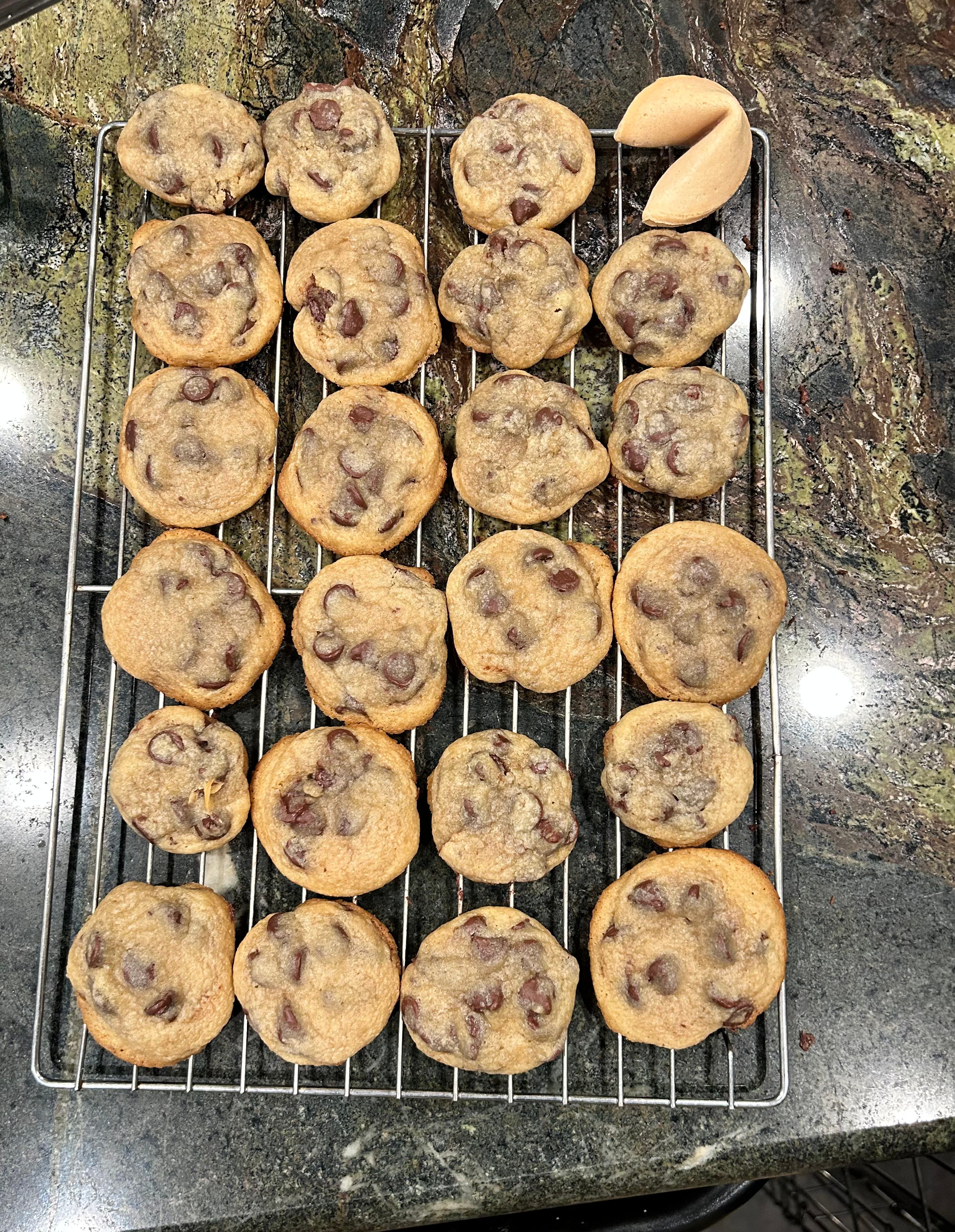
I collected new recipes throughout high school. I made Martha Stewart’s soft and chewy chocolate chip cookies, banana bread muffins, and dinner for my family frequently. But I started to wonder: Was I baking because I liked baking or because I liked the attention from my peers I got afterwards?
My mom encouraged me to get a diagnosis again right before I turned eighteen, and we made an appointment with a clinical psychologist just before I left for college. For my joint graduation, birthday, and going away party I made 200 chocolate chip cookies. They were sitting in a disposable aluminum tray with big tubs of vanilla and cookies & cream ice cream next to them. Everyone loved them. Several of my dad’s cousins told me they had eaten four. We ran out, even though my mom insisted we would have too many leftover.
I did the psychological assessment: I had to copy pictures, spell words out loud, press the spacebar on a janky computer when a letter came on the screen (unless the letter was x), and answer many long questionnaires. For one test, I was asked to rate how strongly I agreed with a series of given statements. One statement was: “I am fascinated by dates.” I was confused by the statement and still am, no I don’t recite dates or spend a long time thinking about them. At least I don’t think I do, but I do remember being a little disappointed after December 12th, 2012 when I realized there wouldn’t be another date like that in my lifetime—but it’s not like I actively thought about it. I bubbled in slightly disagree with my pencil.
After my testing was done, I saw an autistic TikToker explain that she couldn’t tell if the question was referring to calendar dates, going on dates, or the fruit. It helped me feel much less alone in my confusion. Every experience and interaction an autistic person has is influenced by their autism. Why is it, then, that the psychologists and pediatricians who diagnose us refuse to acknowledge that our autism would impact the way we take the test? When I first told my doctor I wanted to get tested I lost my voice because I was having a verbal shutdown. Instead of seeing this as a further indicator that I needed help, she saw it as a reason to take me less seriously. When autistic people like me communicate our needs too clearly, it's seen as proof that we don’t have needs after all, but when we fail to communicate people think we’re beyond help.
My post-assessment documentation has a section outlining my behavior during the test. It states that: “The patient arrived on time for the evaluation. She was comfortably dressed and well-groomed.” My mom drove me to the appointment and the psychologist knew that. So why would she assume my timeliness had to do with me? And how did she know that I was comfortable? She never asked me. What would she have written if I was wearing a dress and jewelry?
When the results of the assessment came back, I was alone at my university in New York City. I found out at 7pm while sitting in an empty room at the school’s writing center, on a three way call with the psychologist and my parents. I assumed that I would meet with her later and get a pep talk or a complementary fidget toy for my trouble—a pathetic consolation prize. That never happened. After the initial glee upon learning that I was right about myself, I became depressed and had to move home.
Two months later, I made cookies for Micah’s graduation. My parents made sure I knew I didn’t have to, but I wanted to. I needed to do something I knew I would be good at. So, I stood behind a table at my uncle’s house as Micah’s friends and all our relatives came up to get dessert. I asked them each if they wanted a cookie and got to talk to them a bit. I realized afterwards how perfect it was. One person at a time came up to me and I had a script for how to start the conversation, it was on them if they wanted to talk to me more. I could talk to people without worrying if I was interrupting them, and our conversations had a natural endpoint because there was a line of people waiting.
Nobody told me how to reprocess my life. According to the National Autistic Society, a non-profit that works for the rights of autistic people in the UK: “Masking is a strategy used by some autistic people, consciously or unconsciously, to appear non-autistic in order to blend in and be more accepted in society.”3I don’t know when I started doing this, but whenever I’m in a one-on-one conversation with someone I consciously move my eyes from one of their eyebrows, to their nose, to their other eyebrow. I didn’t realize that not everyone did this. I didn’t realize that not everyone was studying books and TV shows to learn how other people interacted. After getting the diagnosis, I wanted to stop masking altogether. This proved to be extremely difficult. How do you figure out which parts of yourself are really you and which parts of yourself are coping mechanisms meticulously crafted since you were three or four or five years old?
I’ve come to realize that the act of bringing cookies to school after I made them in my KitchenAid Artisan Series, 5-Quart, Tilt-Head Stand Mixer was a mixture of both. I’ve been fascinated by the kitchen my entire life. I’ve also molded my interest into something I’m not sure I like. I think I’ve lost my desire to make mass amounts of baked goods. When I was younger, I needed time alone to shut out the world and make something. I don’t need that as much anymore because I no longer wear clothes that hurt, and the forks I hate touching are in their separate drawer. I’ve always known that cooking is an act of love, but I never questioned who I was giving my love to.
I felt like I had to get attention from my peers, in order to have a fulfilling life. Now, with a diagnosis that explains my difficulty with friendships. I’m starting to figure out what kind of relationships I even want to have. I don’t need to put so much effort into appeasing strangers.
The last time I made cookies was for my church. The hospitality team decided to offer every visitor a cookie, so we keep homemade cookies in the freezer to warm when someone new comes in. My mom helped me make my aunt’s sugar cookie recipe, and I got a ride to church early so I could put them in the freezer before service started.
Baking is no longer the only way I show love to myself and others. It’s become a fun activity instead of a necessity.I have new skills for interacting with the world aside from presenting baked goods to strangers, but it doesn’t mean I’ll ever get rid of my love for my KitchenAid Artisan Series, 5-Quart, Tilt Head Stand Mixer.
American Psychiatric Association: Diagnostic and Statistical Manual of Mental Disorders, Fifth Edition. Arlington, VA, American Psychiatric Association, 2013.
American Psychiatric Association: Diagnostic and Statistical Manual of Mental Disorders, Fifth Edition. Arlington, VA, American Psychiatric Association, 2013.
“Masking.” National Autistic Society, www.autism.org.uk/advice-and-guidance/topics/behaviour/masking Accessed 25 June 2024.